Treasury Buybacks Are Not QE: What the Hype Gets Dead Wrong
If you spent any time on financial social media this week, you heard two words repeated like a drumbeat: Treasury buybacks. Within hours, the comparisons flew — “QE light,” “Operation Twist,” “stealth money printing.” Gold spiked 3.6% in a single day. Everyone had an opinion. Almost nobody had the facts.
Let’s fix that.
What a Treasury Buyback Actually Is
Start with the basics. The US Treasury Department borrows money by issuing different types of debt securities. Treasury bills (T-bills) are short-term loans — think 4 to 8 weeks — that the market absolutely loves. Treasury notes and bonds are longer-term, ranging from 2 to 30 years.
A buyback works like this: the Treasury deliberately issues more T-bills than it actually needs. Say the government needs to raise $100 billion. Instead, it raises $104 billion. It now has $4 billion in extra cash. It then takes that $4 billion and uses it to buy back older, longer-term Treasury bonds already trading in the market.
Simple enough. But here’s the crucial detail that everyone is missing: the government isn’t buying just any bonds. It’s specifically targeting what are called off-the-run securities — bonds and notes that were auctioned months or years ago and no longer have an active, liquid trading market.
Why Off-the-Run Bonds Are the Real Story
The US Treasury market is often called the deepest and most liquid market in the world. That’s true — but only for on-the-run securities, meaning the most recently auctioned bonds. Once a bond is replaced by a newer issue, it becomes off-the-run, and liquidity (the ease of buying or selling quickly without moving the price) drops sharply.
This created a genuine problem that became impossible to ignore in March 2020. When the pandemic hit, global reserve managers — central banks and sovereign wealth funds that hold US Treasuries as their primary safe asset — had to sell their holdings fast to raise dollars. The technical term for this scramble is a dollar shortage: a sudden global demand for US dollars that outstrips supply.
The problem? The bonds they were selling were off-the-run. The dealer network — the big banks that act as intermediaries in bond trading — couldn’t absorb or repo (use as collateral for short-term loans) those securities fast enough. Prices cracked. The “deepest market in the world” seized up.
The Treasury’s response, conceived years later, was elegant in its simplicity: create a standing program where the government itself acts as a regular buyer for off-the-run securities. As Assistant Secretary for Financial Markets Joshua Frost explained, buybacks are expected to encourage dealers to make markets for off-the-run securities, “as they will have Treasury as a regular and predictable buyer” (Reuters). This gives the market confidence that there’s always a buyer of last resort for illiquid bonds, reducing the risk of another March 2020-style freeze.
That is the entire purpose of the buyback program. It is a technical plumbing fix for a specific structural weakness in the Treasury market. It is not monetary policy. It is not money creation. It is the bond market equivalent of the government agreeing to take your old furniture so the garage sale doesn’t collapse.
The Numbers Make the Hysteria Look Absurd
When the Treasury first launched this program in May 2024 — yes, it has been running for over a year already — the scale was $2 billion per operation for coupon securities (notes and bonds), plus $500 million for TIPS (Treasury Inflation-Protected Securities, bonds whose principal adjusts with inflation).
The announcement that triggered this week’s frenzy? The pace was doubled — from $2 billion to $4 billion.
For context: the US Treasury routinely auctions off $100 billion or more in a single week of T-bill sales alone. The buyback program represents a rounding error on a rounding error. Calling this money printing is like watching someone pour a cup of water into the ocean and warning of a flood.
This Has Happened Before — Multiple Times
Here’s what makes the recurring outrage especially frustrating: Treasury buybacks are not new.
The US government ran buyback programs in the 1920s and 1930s. The modern era saw them revived in March 2000, when the Clinton administration faced the opposite problem — surpluses were so large that the Treasury was running out of long-term bonds to sell. Markets needed those bonds as collateral (assets pledged to secure loans), so the Treasury bought back old bonds to manage supply. Nobody called it money printing. People understood the context.
Then in October 2022, as long-term bond yields began spiking, the Yellen Treasury Department floated the idea again. Same hysteria, same “stealth QE” accusations, same gold spike. Then it faded. In May 2024, with the 30-year Treasury yield climbing again and an election approaching, the program officially launched. Same hysteria again. Then it faded again — until this week, when doubling the pace generated yet another round of identical, unfounded panic.
Notice the pattern: the program gets announced or expanded exactly when long-term rates are rising and the political optics are bad. The buyback is a symbolic gesture designed to make it look like the government is doing something about interest rates — even though $4 billion in bond purchases cannot meaningfully move a market measured in tens of trillions.
Both Sides Are Running Disinformation
Here’s the uncomfortable truth: both sides of this debate are misleading you, just in opposite directions.
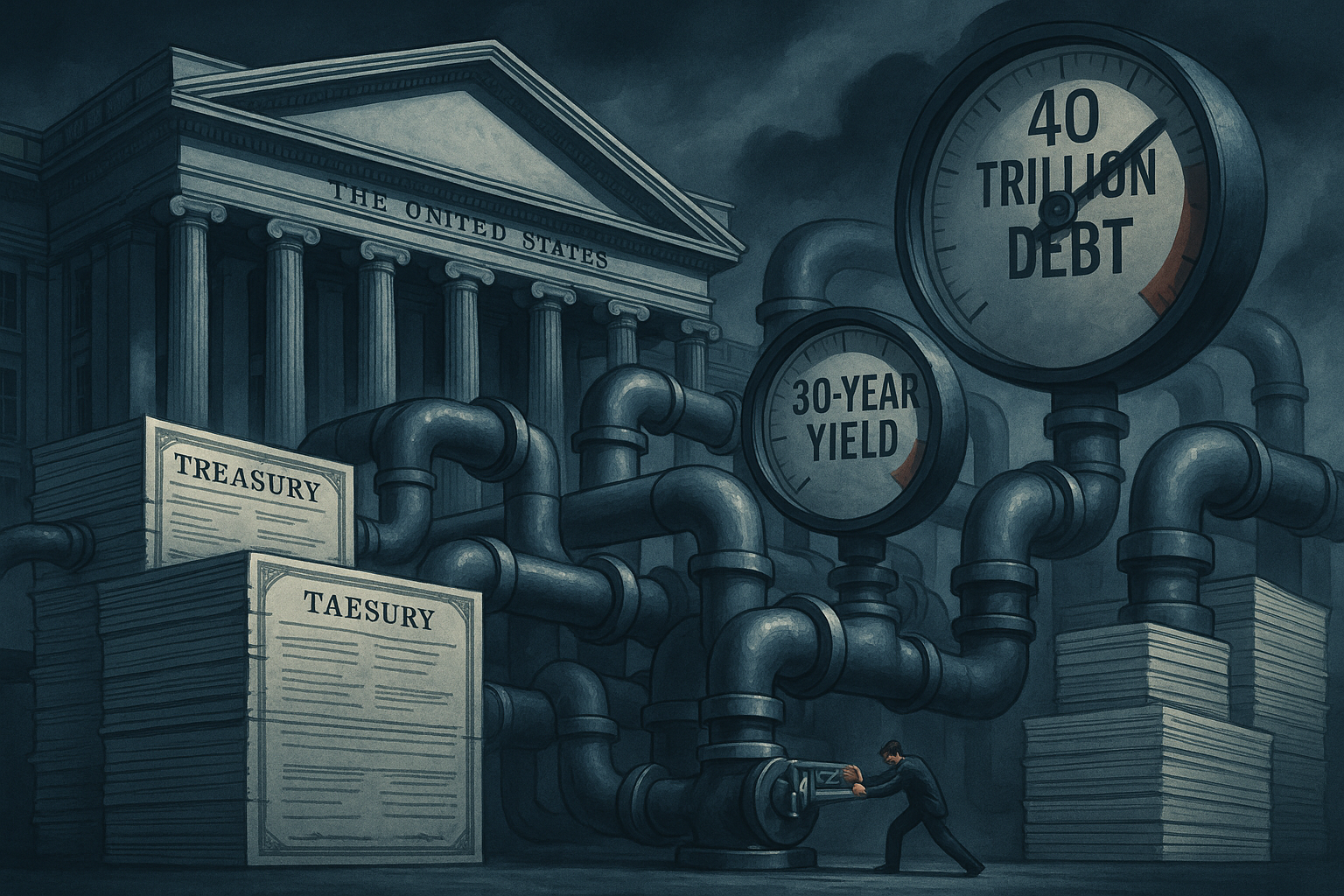
The government wants you to think it has the ability to control interest rates — a concept called yield curve control (a policy where authorities explicitly cap borrowing costs at certain maturities). Announcing a buyback program gives the impression of active yield curve management and helpfully shifts headlines away from the $40 trillion national debt and the 30-year Treasury yield hitting its highest level since 2007.
The critics — gold bugs, deficit hawks, perma-inflationists — want this to be QE (quantitative easing, where a central bank creates new money to buy assets and expand its balance sheet) because they’ve been predicting hyperinflation since 2008 and need every government action to confirm that prediction.
Neither is correct. The buyback isn’t QE because the Treasury is not creating new money — it’s recycling existing cash raised from T-bill sales. And it isn’t yield curve control because $4 billion cannot control a $28 trillion Treasury market.
What About the Gold Spike?
Gold’s 3.6% single-day jump was real. But zoom out. Gold had already been rising sharply for weeks before this announcement, driven by safe-haven demand and concerns about the dollar’s global role — themes deeply connected to the eurodollar system (the vast network of US dollar-denominated credit created outside the US by global banks). The buyback announcement simply handed social media a “money printing” narrative that gave momentum traders an excuse to chase a move already underway.
Gold isn’t rising because the Treasury is about to flood the world with dollars. It’s rising because the deeper signals in global dollar funding markets point to structural stress that has nothing to do with a $4 billion buyback program.
The Takeaway
Treasury buybacks are a small, technical tool designed to patch a specific liquidity problem in the market for off-the-run bonds — the same vulnerability that nearly broke global markets in March 2020 during a classic dollar shortage. The program has been quietly running since May 2024. Doubling it changes almost nothing of substance.
What it does change is the news cycle — which is precisely the point. When the 30-year yield is at a 19-year high and the national debt just crossed $40 trillion, the last thing Washington wants is for people to focus on those facts. A buyback announcement guarantees that critics scream “money printer” and supporters cheer “yield curve control,” and suddenly nobody is talking about the debt.
Understanding this dynamic — the gap between what financial tools actually do and what politicians and pundits say they do — is exactly what the eurodollar framework is built to expose. The plumbing of global money matters far more than the headlines above it.
Leave a Reply