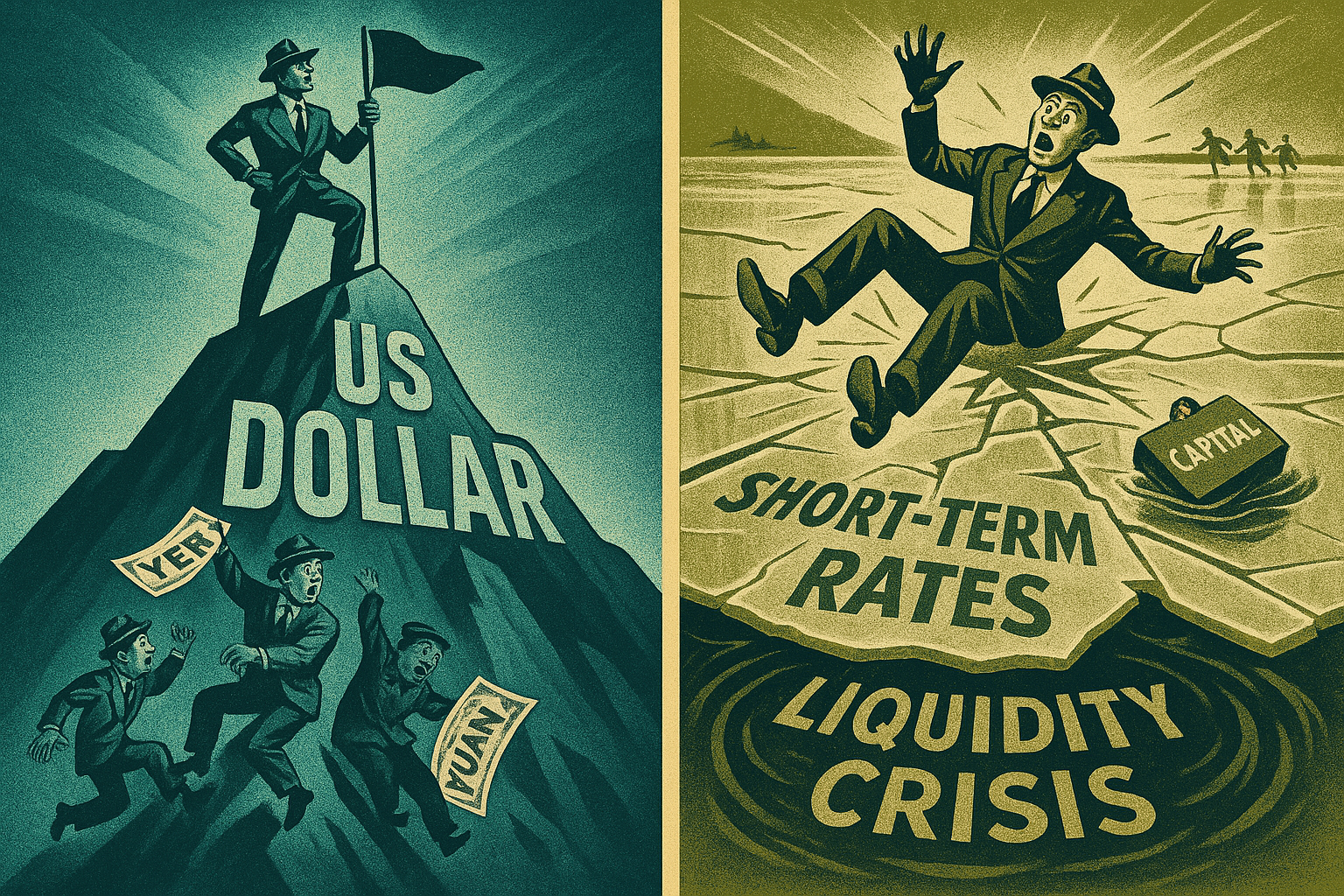
Why a Rising Dollar and Falling Short-Term Rates Are Saying the Same Scary Thing
Here’s a puzzle that should make you stop scrolling: the US dollar is surging against Asian currencies — crushing the Japanese yen, the South Korean won, Indonesia’s rupiah, and India’s rupee — while at the very same moment, short-term US dollar interest rates are quietly falling. That sounds like a contradiction. Higher dollar usually means higher rates, right? Wrong. And understanding why these two things are actually the same signal is one of the most important things you can know about how the global financial system really works.
The Mainstream Story (and Why It’s Wrong)
The financial media has a simple explanation for the strong dollar: the Federal Reserve’s interest rates are higher than those of Asian central banks, so money flows toward the US for better returns. Rate differentials. Carry trades. Simple.
But if that were true, why are short-term dollar markets — specifically SOFR futures (contracts that bet on where overnight US dollar lending rates will go) and Treasury bill yields — increasingly pricing in lower rates ahead, not higher ones? If the world were rushing into dollars because US yields are so attractive, you’d expect front-end rates to stay elevated or climb. Instead, they’re drifting down, with the one-month tenor dropping sharply.
This isn’t a contradiction. It’s a signal — and both halves of it are pointing to the same underlying stress.
What’s Actually Driving Asian Currency Weakness
To understand the dollar surge, you have to understand what the eurodollar system (US dollars held and lent in banks outside the United States, forming the backbone of global trade and finance) actually does. Most of global trade — energy, commodities, shipping — is invoiced in dollars. Asian countries don’t just want dollars; they need them to function.
Japan: An Energy Bill Problem
Japan imports nearly all of its energy. When oil prices rise, Japan needs more dollars to pay for the same barrels of crude. That mechanical demand for dollars pushes the yen lower — not because speculators are running wild, but because Japan’s balance of payments (the accounting of all money flowing in and out of a country) requires more dollar outflows. Tokyo can threaten intervention (selling dollars from its reserves to prop up the yen) all it wants, but intervention doesn’t change the energy bill.
South Korea: A Trade Barometer
South Korea’s won acts like a real-time gauge of global dollar liquidity (the ease with which dollars can be borrowed and accessed worldwide) and trade health. Korea is deeply embedded in global supply chains — semiconductors, manufacturing, exports. When global trade looks shaky and dollar funding tightens, the won feels it immediately.
Indonesia: The Emergency Rate Hike That Didn’t Help
Bank Indonesia (Indonesia’s central bank) delivered an unexpected 50 basis point (0.50 percentage point) rate hike to defend the rupiah, which had hit record lows (Reuters). It barely moved the needle. Why? Because the rupiah isn’t weak due to Indonesian monetary policy mistakes. It’s weak because global dollar funding conditions are tightening, foreign investors are pulling back from local currency bonds, and energy import costs are rising. A rate hike doesn’t fix any of that.
India: When Gold Becomes a Dollar Story
India’s situation is perhaps the most revealing. When Indian officials start worrying about gold and silver imports — culturally sacred purchases for hundreds of millions of people — you know this has moved beyond currency charts. India can’t stop importing oil; it needs energy to run the economy. But gold is what officials call a “discretionary dollar drain.” Restricting gold imports is the government’s way of conserving dollar reserves. The public sees gold as protection. The government sees gold as dollar leakage. That’s a dollar shortage in action.
Intervention: Theater With a Shrinking Half-Life
Every time an Asian central bank intervenes — selling dollars to buy its own currency — it reallocates existing dollar reserves temporarily. It might rattle leveraged traders for a day. By the third or fourth intervention, markets start asking the obvious question: how much are they willing to spend before they stop? Intervention doesn’t create new dollars. It doesn’t change energy import costs. It doesn’t fix private dollar funding conditions. And it can backfire: selling dollars drains local liquidity, potentially tightening domestic money markets at the worst possible time.
The Front End Is Whispering Something Critical
Now for the truly shocking part. While all of this dollar stress is playing out across Asia, the very front of the US dollar interest rate curve is doing the opposite of what headline-obsessed commentators expect.
Treasury bill yields (yields on short-term US government debt, maturing in days to a year) have been drifting lower. Term SOFR (the expected average of overnight dollar lending rates over coming months) has been falling. SOFR futures — essentially market bets on where short-term rates are headed — are pricing a growing probability that the Fed’s next move is a cut, not a hike. This is happening while central bankers worldwide are still talking tough about inflation.
To be clear: the market isn’t predicting emergency rate cuts next month. It’s hedging the risk that policymakers can’t follow through on their hawkish script. And history backs this up. The European Central Bank hiked rates into energy-driven inflation shocks in 2008 and again in 2011 — both times, it mistook a temporary oil-driven CPI spike for durable inflation, and both times the economy turned ugly shortly after.
The Dollar Shortage Playbook
Here’s the key insight that ties everything together. There are two ways the dollar can be “strong”:
- Risk-on strength: The world wants dollars because the US economy is booming and returns are high. This is genuinely bullish.
- Stress-driven strength: The world needs dollars because energy bills, trade invoices, debt service, and funding obligations are all coming due simultaneously and dollar availability is shrinking. This is a warning.
Right now, we are firmly in scenario two. Japan doesn’t need dollars because America is booming. It needs dollars because oil is expensive. India isn’t restricting gold because US yields are attractive. It’s restricting gold because the dollar drain is already severe. The dollar rises because the system is stressed. Short-term rates fall because that same stress raises the probability of a macro slowdown that forces central banks to eventually reverse course.
Energy shock → dollar shock → macro shock → central banks pivot. That’s the sequence the front end of the dollar market is beginning to price.
What to Watch
The signals are hiding in plain sight. Watch dollar-yen and whether Tokyo’s interventions are losing their punch. Track India’s import restrictions on gold and silver — they’re a real-time dollar stress indicator. Monitor Indonesian reserves and how long that rate hike holds. Check the shape of the SOFR futures curve: if front-end rates keep falling while the dollar stays strong, that’s not confidence. That’s the market looking past the headline CPI and seeing the damage beneath.
Conclusion
The eurodollar system — that vast, largely invisible web of dollar-denominated lending, trade, and finance operating outside US borders — doesn’t care about central bank press releases. It runs on dollar availability, and right now, availability is tightening. The rising dollar across Asia and the falling short-term rate expectations in US markets aren’t telling two different stories. They’re both reading the same one: an energy shock has become a dollar shock, and a dollar shock has a habit of becoming a macro shock. The last thing you see before the global economy rolls over is headline inflation from oil — and that’s exactly what central bankers are currently fixated on, while the real damage builds quietly underneath.
Sources
- Indonesia’s plunging rupiah twists the policy plot — Reuters
- Original source: Jeff Snider — YouTube
Leave a Reply