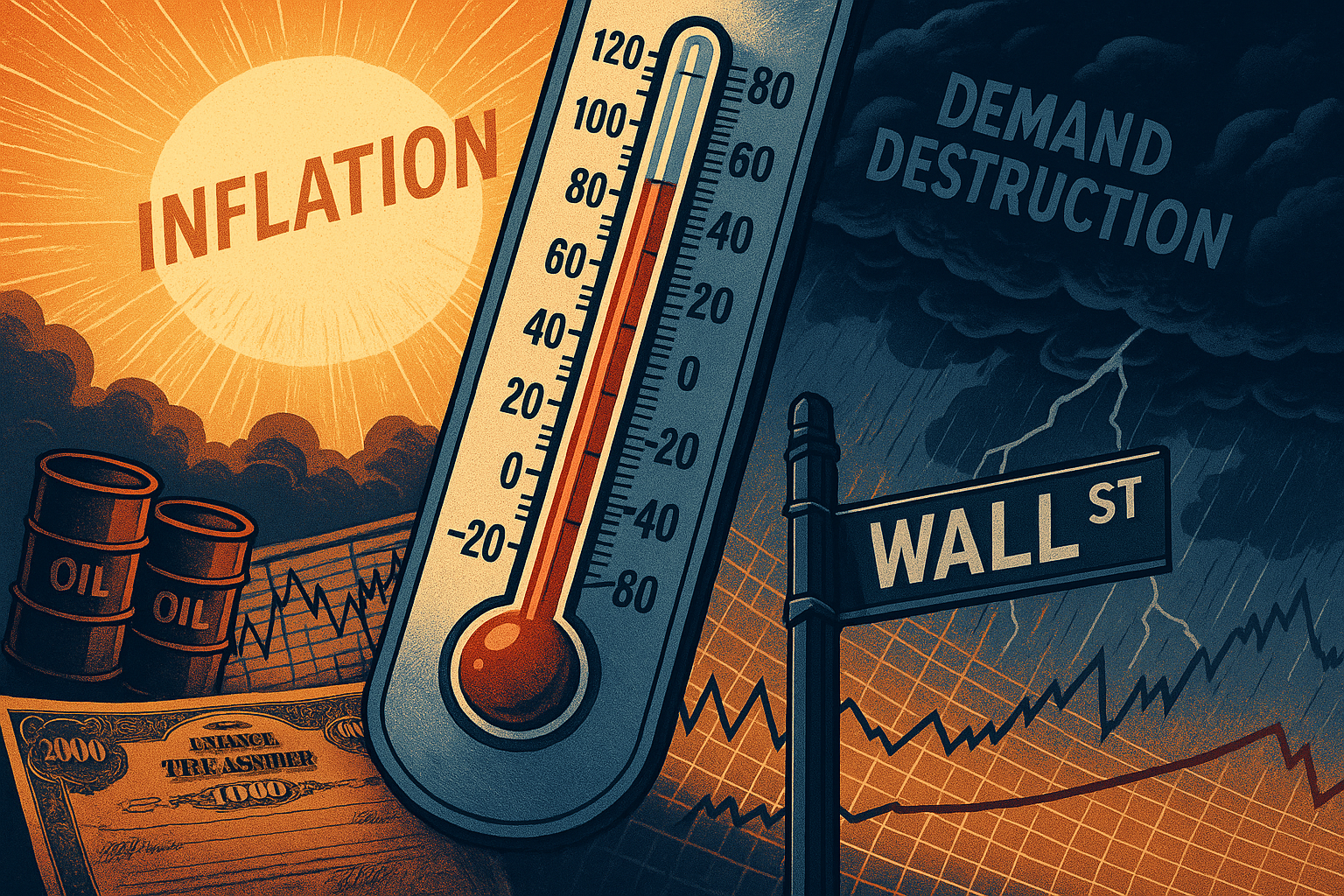
June CPI Shocker: Why Falling Prices Are a Red Flag, Not a Victory Lap
Prices fell sharply in June. That sounds like great news for your grocery bill — and on a personal level, it is. But in the world of global monetary mechanics, a sudden drop in the Consumer Price Index (CPI, the government’s main measure of inflation across everyday goods and services) is flashing warning signs that have nothing to do with relief at the gas pump. In fact, the June CPI report contains some of the most alarming signals since April and May of 2020. Here’s what the numbers are actually telling us — and why the Federal Reserve may be looking in entirely the wrong direction.
The Headline Numbers: Bigger Than Expected
Analysts expected a modest monthly decline in June, driven mainly by falling gasoline prices. Energy did pull back — motor fuel costs dropped nearly 10% on the month. But the overall CPI fell by almost half a percent in June alone, the steepest single-month drop since April 2020. That’s not a rounding error. That’s a signal.
More importantly, it isn’t just about gas. The core CPI (the inflation measure that strips out volatile food and energy prices, leaving everything else) actually turned fractionally negative for the first time since May 2020. When even the core rate is falling, it means something broader is happening in the economy.
The annual inflation rate slipped from above 4% back to around 3.5% — below expectations and moving in the “right” direction. But again, why it’s moving matters more than the direction itself.
Why the Fed Was Watching the Wrong Thing
The Federal Reserve’s current concern is a concept called second-order effects — the idea that when energy prices rise, businesses face higher costs and pass those costs onto consumers, who then demand higher wages, which pushes prices higher still, spiraling into the kind of runaway inflation seen in the 1970s. That’s the ghost the Fed has been chasing.
Their logic goes like this: oil goes up → a service provider’s fuel and electricity bills rise → that provider raises prices → next provider raises prices → inflation spreads everywhere. To prevent that spiral, the Fed raises its short-term policy rate (the interest rate it charges banks to borrow overnight, which ripples through the whole economy).
The June data says that spiral simply isn’t happening. Services prices — which is precisely where second-order inflation would show up first — are falling, not rising. The section of the CPI that strips out food, energy, and shelter posted its weakest reading since May 2020. There is no inflation contagion in the data. What there is, instead, is demand destruction.
Demand Destruction: The Real Story in the Numbers
Demand destruction means consumers and businesses are pulling back on spending — not because they’re choosing to save, but because they genuinely can’t afford to keep spending at previous levels. Businesses facing higher input costs aren’t raising prices; they’re finding out their customers won’t pay more. So instead, they’re squeezing margins, cutting worker hours, shifting employees from full-time to part-time, and in some cases laying people off.
Walmart’s recent public statement captured this perfectly: the retailer said it would cut prices, not raise them. That’s not a company worried about inflation running hot. That’s a company responding to weak consumer demand.
This dynamic also lines up with what consumer surveys have been showing. The University of Michigan and the Federal Reserve Bank of New York’s own consumer expectations surveys aren’t showing fears about inflation. They’re showing fears about jobs and income. People aren’t worried prices will spiral upward — they’re worried about whether they’ll still have a paycheck.
The TIPS Market Already Knew
TIPS (Treasury Inflation-Protected Securities) are US government bonds whose payouts adjust with inflation. The breakeven rate is the difference in yield between a regular Treasury bond and a TIPS bond of the same maturity — essentially a real-time market signal of how much inflation protection investors are demanding.
When breakeven rates fall sharply, it means investors are reducing their demand for inflation protection, because they don’t think inflation is coming. Since late May, breakeven rates have been plummeting across the 5-year and 10-year maturities. The market was never pricing a 1970s-style inflation breakout from the Iran-driven energy shock. It was pricing a short-term bump followed by demand-driven disinflation — exactly what the June CPI confirmed.
The 5-year, 5-year forward rate (a measure of long-run structural inflation expectations, five years out, for the following five years) has held steady for years through every energy shock — OPEC cuts, Yemeni rebel disruptions, tariff scares, now Iran. The market’s long-run verdict hasn’t changed: this is not a monetary inflation problem. It never was.
The Twist in the Oil Futures Curve
Oil markets are also sending a split signal worth understanding. Following the latest Middle East flare-up and renewed concerns about Iranian supply disruptions, front-month WTI futures (contracts for oil delivered in the next 30 days) surged nearly 2% in a single morning. But contracts for delivery three to six months out? They fell.
This shape — near-term prices rising while longer-dated prices decline — is the oil market saying: yes, there may be a short-run supply squeeze, but we expect demand to weaken enough that oil gets cheaper over time. It’s a demand destruction signal embedded directly in the futures curve. As Reuters has reported, US oil futures backwardation has been narrowing amid mounting fears of a glut, consistent with this broader thesis.
China’s oil import data reinforced the point: a 40% year-over-year drop in the volume of oil imported into China in June. Demand destruction isn’t a US-only story. It’s global.
The market structure briefly touched contango (a state where future delivery prices are higher than near-term prices, signaling expected oversupply down the road), and the current twist in the curve is consistent with that broader thesis: too much oil coming, not enough demand to absorb it.
The Fed’s Jean-Claude Trichet Moment
Here’s the historical parallel that should make everyone uncomfortable. In 2008, Jean-Claude Trichet — then president of the European Central Bank (ECB) — actually raised interest rates in the middle of the year, citing inflation fears from rising energy prices. He did this in between the collapse of Bear Stearns and the collapse of Lehman Brothers. He looked at oil prices, ignored every other signal the market was screaming, and tightened monetary policy into an unfolding catastrophe.
The Fed today is at risk of making the same mistake. With Fed Governor Christopher Waller and Treasury Secretary nominee Kevin Warsh both talking tough on inflation, markets are now pricing in a meaningful probability that the Fed raises its policy rate again — perhaps even twice — despite there being no evidence of second-order inflation effects anywhere in the data.
The 2-year Treasury yield has run up sharply, not because markets expect inflation, but because they expect the Fed to act on its inflation fears regardless of the data. The yield curve (the spread between short-term and long-term Treasury yields) has flattened dramatically as a result — the 10-year/2-year spread compressing toward near-inversion — a classic signal that markets believe the Fed is tightening into weakness, not strength.
What This Means for the Eurodollar System
The eurodollar system (the vast, largely invisible network of US-dollar-denominated lending and borrowing that happens outside the United States, in offshore banks and financial markets) is fundamentally a system built on credit and demand. When demand weakens globally — when Chinese oil imports crater, when American consumers can’t absorb higher prices, when businesses absorb margin compression rather than passing it on — that weakness transmits through the eurodollar system long before it shows up in official statistics.
The June CPI isn’t just a number. It’s a data point confirming what the TIPS market, the oil futures curve, and consumer surveys have been signaling for months: the global monetary environment is tightening on its own, independent of anything the Federal Reserve decides to do. If the Fed hikes anyway, it risks amplifying that tightening at exactly the wrong moment — and history has a name for central banks that made that mistake.
The signals were there. They’re always there. The question is whether the people setting policy are willing to look at them.
Sources
- US oil futures backwardation narrows to 20-month low on mounting fears of a glut — Reuters
- Original source: Jeff Snider — YouTube
Leave a Reply