The Fed Sees Inflation. Every Other Market Disagrees. Here’s Why the Bond Market Is Right.
Oil prices are surging. The Federal Reserve is threatening to raise interest rates. The financial media is buzzing about inflation. On the surface, the story seems obvious: prices are going up, and the central bank needs to act.
But there’s a problem. Nearly every corner of the financial market — bonds, oil futures, inflation derivatives, currency markets — is telling a completely different story. And the market has a much better track record than the Fed. Here’s what’s actually going on.
Two Competing Narratives
The Federal Reserve’s view rests on two pillars. First, the U.S. labor market and broader economy are, in their word, resilient — not great, but holding up. Second, rising oil prices create an inflation risk that the Fed must squash before it spreads.
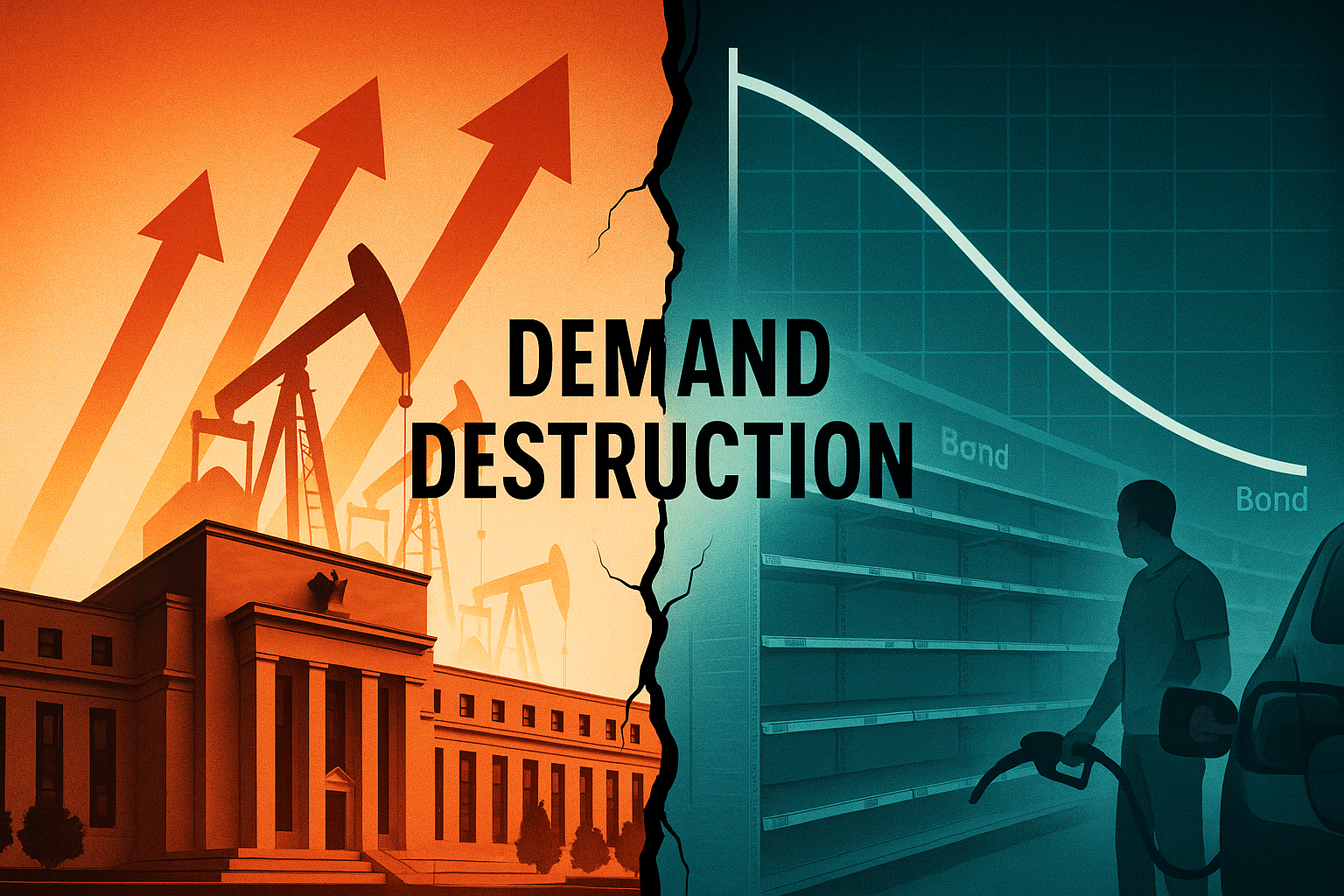
The market’s view is simpler and harsher: the economy is not resilient, and higher oil prices won’t cause lasting inflation — they’ll cause demand destruction.
Demand destruction is exactly what it sounds like: prices rise, people can’t afford to keep spending, so they buy less. That collapse in buying activity eventually drags prices back down — and takes jobs with it.
The difference between these two views has enormous consequences for your savings, your investments, and whether the Fed is about to make a serious policy mistake.
What Nestle, Tractor Supply, and a French Fry Company Are Telling Us
The bond market doesn’t just react to government statistics. It listens to what real companies are reporting.
This week, Nestle — a global food giant that sells products to ordinary American households — revealed that when it tried to raise prices in North America, its sales volumes fell (Reuters). Not by a catastrophic amount: down about 0.6% when they had been expected to rise a couple of percentage points. But that small miss sends a loud signal.
In a truly inflationary environment, companies raise prices and consumers grudgingly pay up. Instead, Nestle raised prices and consumers cut back. That’s demand destruction, not inflation.
The same pattern is showing up elsewhere. Walmart shoppers are pumping less than $10 of gas at a time, just enough to get to the next paycheck. McDonald’s is trying to cut prices to win customers back. A major supplier of frozen french fries is reporting weaker orders.
These aren’t anecdotes. They’re a consistent signal that consumer spending power is eroding — the exact opposite of what you’d expect in an inflationary boom.
The Oil Market Knows Something the Fed Doesn’t
Oil prices have spiked recently, partly driven by Middle East tensions. But here’s the critical detail: only the nearest futures contracts have moved sharply higher.
Futures contracts are agreements to buy or sell oil at a set price on a future date. The front-month contract (oil for immediate delivery) has surged roughly $20. But the contract for oil in December 2026 or June 2027 barely budged — up perhaps $1–2.
What does that tell us? The oil market believes the current supply disruption is temporary. It does not believe, however, that supply will simply normalize peacefully. The far more likely explanation for falling longer-dated prices is anticipated demand destruction — the market expects the economy to weaken enough that people simply won’t need as much oil.
If oil itself isn’t expecting lasting high prices, it’s very hard to argue that oil is triggering a sustained inflation spiral.
The TIPS Market: The Dedicated Inflation Gauge That’s Not Worried
TIPS — Treasury Inflation-Protected Securities — are U.S. government bonds specifically designed to track inflation expectations. When investors expect inflation, TIPS breakeven rates (the gap between regular Treasury yields and TIPS yields that reflects expected inflation) rise. When they don’t, those rates stay flat.
Oil prices have screamed higher. TIPS breakeven rates have barely twitched — moving only about 5–6 basis points (a basis point is one-hundredth of a percentage point, a tiny move). The market that exists specifically to price inflation is essentially shrugging at rising oil.
This happened earlier in the year too, when oil spiked in March and April. TIPS moved a little, then stopped. The message then was: short-term CPI bump, nothing lasting. The message now is even clearer.
Why Are the 2-Year Treasury Yields Rising, Then?
This is the key question that trips people up. The 2-year Treasury yield (the interest rate on U.S. government debt maturing in two years) has been climbing, and many interpret that as the market pricing in inflation.
It’s not.
The 2-year yield is rising because the market is pricing in the risk that the Fed actually raises rates — not because inflation is genuinely breaking out. There’s a crucial difference. Think of it this way: if inflation were the real driver, you’d expect long-term yields to rise even faster, because investors would demand more compensation for years of eroded purchasing power. Instead, the yield curve (the difference between short-term and long-term rates) is flattening — short rates rising while long rates barely move.
A flattening yield curve is a classic signal that the market sees no real growth or inflation ahead. It’s the bond market’s way of saying: “We know the Fed might hike, but we think it’s a mistake, and we’ll be cutting rates again soon.”
The Swap Market Seals the Case
Interest rate swaps are contracts where two parties exchange interest payments — one fixed, one floating — over a set period. The swap market is, arguably, even more important than the Treasury yield curve as a gauge of where rates are truly headed.
As the Fed has grown more hawkish in its rhetoric, swap spreads — specifically short-term ones — have been turning increasingly negative. That means the swap market is diverging from the Fed’s guidance, effectively saying: “You think you’re going to be Paul Volcker (the Fed chair famous for crushing 1970s inflation with brutally high rates), but you’re not. You’re going to end up cutting.”
We’ve Seen This Movie Before
This setup is not new. In 2024, the identical dynamic played out around tariff fears. The Fed worried about inflation, the media amplified it, and the market quietly said no. By summer, payroll reports turned negative, layoffs accelerated, and the Fed pivoted to cutting rates — shocking consensus forecasters who had been certain the labor market was unbreakable.
The difference this time is that energy, not tariffs, is the inflation trigger — and the Fed appears more likely to actually pull the rate-hike trigger this cycle. But the endpoint, according to every major market signal, is the same: a rate-hike that gets reversed within months as the economy buckles.
What This Means for the Eurodollar System
This disconnect between Fed rhetoric and market reality is at the heart of how the modern monetary system — built on eurodollars (U.S. dollars held and traded in banks outside the United States) — actually functions. The eurodollar system doesn’t care about Fed press conferences. It cares about credit demand, collateral availability, and global economic activity.
When Nestle’s volumes fall, when french fry orders dry up, when Walmart shoppers pump $8 of gas instead of filling the tank — that is the eurodollar system signaling contraction, not expansion. The Fed is looking at lagging labor market headlines. The global monetary system is already pricing in what comes next.
The Fed will likely hike. The market is already preparing for the cuts that follow.
Sources
- Consumer gulf widens as demand for premium and budget foods grows — Reuters
- Original source: Jeff Snider — YouTube
Leave a Reply